

Podcast | Urban planning sets the stage for improving communities
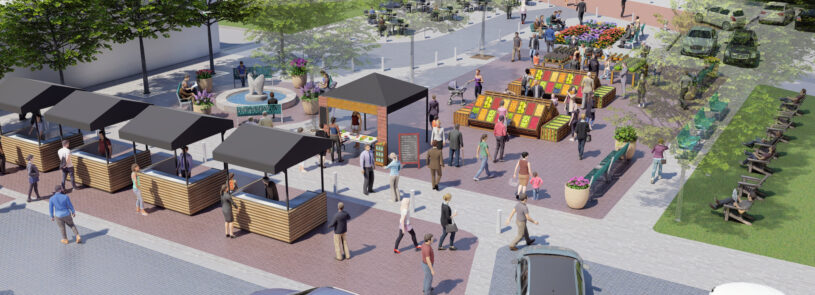
Urban planning is the critical foundation upon which successful infrastructure and community outcomes are built, defining a project before it advances into design, policy, or implementation. So says Susan VanBenschoten, IMEG Director of Urban Design, Planning, and Engagement, who recently discussed the components of urban planning and the expansive services her team provides on IMEG’s podcast, The Future Built Smarter.
“Urban design and planning is really an umbrella of dozens of different services that are integrated during the planning process,” she explains. These services reside in five major groups: transportation planning, engineering, and design; community planning, land planning, and urban design; environmental planning, resiliency planning, and permitting; landscape architecture; and community engagement—which is, Susan adds, “part and parcel to all the rest of the planning that we do.”
These services are used in various combinations, based on the needs of a project, and operate as an interconnected system. “Planning is very broad and by its nature needs to be multidisciplinary,” Susan says, emphasizing the importance of aligning technical, environmental, and social considerations from the outset. Central to this process is problem definition—often more complex than it initially appears. “You’re really backing up to the very beginning of a problem,” Susan says. Whether addressing congestion, land use, or economic challenges, her team relies on data analysis paired with direct community input. “We really try to use data-driven analysis to understand what the problem really is but also listen to the community so we understand what they see the problem is.”
While traditional public meetings and outreach continue to be conducted, technology has expanded the reach and effectiveness of community engagement. “We still hold meetings. We still do walkabouts—walking through communities and seeing firsthand what some of the issues are.” Technology, however, has created ways to involve more of the community with virtual meetings, online surveys, and virtual reality, which allows “people to visualize what we are talking about.”
Depending on the project, this process can result in a comprehensive “roadmap,” particularly in large-scale or area-wide planning efforts. Such a roadmap can include dozens of recommendations, ranging from immediate actions to long-term capital investments. Importantly, such plans are not static documents. “Planning documents are living documents,” Susan says, evolving alongside the communities they serve.
Susan and her team are eager to expand their work across the U.S., collaborating with IMEG’s civil infrastructure and MEP teams to bring more value and successful outcomes to clients. “That’s the power of having planning and engineering and design all under one roof,” she says. “It’s very much in line with IMEG’s purpose of shaping and making better communities.”
Learn more about IMEG’s Urban Design, Planning, & Engagement services.
Listen to the podcast: