
10 things to know when considering mass timber (Podcast included)
By Robert Norton
I’ve spent the past decade designing mass timber buildings of all shapes and sizes—from corporate offices to residential and hospitality spaces. In that time, I’ve watched the use of the material evolve rapidly. Processes have streamlined, the supply chain has improved, and the architectural community, as well as owners and occupants, have embraced the natural warmth and aesthetic appeal of exposed wood.
Most building owners have never used mass timber on a project before, however. For them, there is much that should be understood and considered before committing to the material, which provides many benefits in the right situations. Here are several important points to keep in mind when evaluating whether mass timber is the right fit for a project.
1. Design for mass timber from the start. If you have designed for steel or concrete and then ask the team to “convert it to mass timber,” you will almost certainly see a 25 percent to 30 percent cost premium. That’s the wrong way to approach it. To make mass timber competitive, it needs to be part of the project from day one. When we design the grid, spans, and systems specifically for mass timber—and coordinate with the engineers—the structural efficiency increases dramatically. Pair that with an accelerated construction schedule and lighter building weight (which saves on foundations and seismic systems) and the economics begin to shift in your favor.
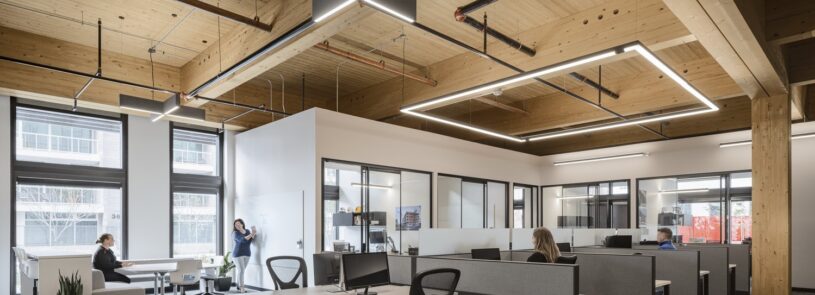
2. Mass timber is beautiful—but that also means most components of the structural system are on display. One of the biggest differences between mass timber and a conventional structural system is that with mass timber, the structure is the architecture. The beams, columns, floor panels, and connections are typically left exposed, becoming part of the finished space. Owners love this—mass timber buildings feel warm, natural, and more comfortable than spaces wrapped in concrete or steel. (Think biophilic design.) But it also means the design team must be highly integrated. They must coordinate early and thoroughly with architects and engineers so every detail is thoughtfully planned. Everything is visible, so everything must show well.
3. Mass timber can be a real time saver. Speed is one of the most compelling advantages. Mass timber arrives on site in large, prefabricated pieces—some as large as 10 feet by 40 feet. These are then craned into place in a fraction of the time it takes to frame conventional systems on site. Because of this, on many projects we can shorten the schedule by upwards of 30 percent for the structure alone—and even more if prefabricated wall and mechanical systems are used. Faster construction means reduced loan carrying costs for the owner and earlier occupancy, which can translate into millions of dollars in savings.
4. Some tenants will be willing to pay more. In some market sectors, tenants are able and willing to pay more for mass timber spaces because they enjoy being in them. I’ve seen owners successfully recoup a significant portion of their investment simply through premium lease rates.
5. Some contractors may be hesitant. The contractors we have worked with, however, have found building with mass timber to be a fast learning curve. If your engineer and architect have experience with the material, they can help your builder quickly understand the process.
6. Supply chain and material differences matter. Timber can be sourced globally—primarily from the U.S., Canada, Europe, and South America—and because the panels ship efficiently, project location rarely limits feasibility. What does vary is appearance. Douglas fir from the Pacific Northwest, for example, has a warm yellow tone, while spruce from Europe is much lighter in color. Many owners and architects care about the color differences, so material sourcing should be discussed early.
7. Fire protection is built in. One of the most common misconceptions is that “wood burns too easily.” Mass timber doesn’t behave like typical framing lumber. The large structural elements char on the outside, forming a protective layer that insulates the core. That allows us to meet one-hour to two-hour fire ratings—often without additional fireproofing.
8. Not all panel systems are equal—especially in seismic regions. In high-seismic areas like California, we rely heavily on cross-laminated timber (CLT) because its layers provide shear strength we can integrate into the lateral system. Other mass timber systems—dowel-laminated timber (DLT), glue-laminated timber (GLT), or nail-laminated timber (NLT)—may work just fine in gravity-only applications or in regions governed by wind rather than seismic requirements.
9. Sustainability gains are significant. Compared to steel and concrete, mass timber offers a meaningful reduction in embodied carbon and makes achieving LEED or other sustainability targets much easier.
10. If it’s right, do it right. If you decide mass timber is right for your project, the best first step is to assemble an integrated design and construction team early. By planning and designing for mass timber from the start, you’ll achieve faster schedules, competitive long-term costs, and a far more sustainable building with an aesthetic occupants will love.
Robert Norton, PE, is a senior structural engineer working out of IMEG’s San Francisco office. To learn more about using mass timber, listen to the IMEG podcast episode below.