

Turn uncertainty into a competitive advantage as industrial technology outpaces codes
By Mike Walsh
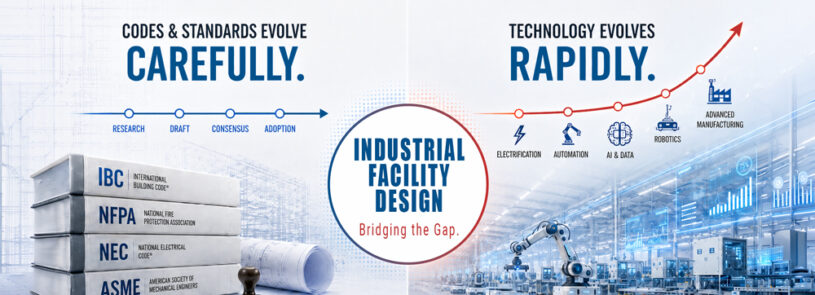
Industrial design is getting harder—not because engineers lack the tools or expertise, but because technology is advancing faster than the codes and standards meant to govern it.
Advanced manufacturing, electrification, automation, and AI-driven operations are causing industrial facilities to evolve at an unprecedented pace. Technologies that were considered cutting-edge only a few years ago are quickly becoming standard expectations. At the same time, regulatory frameworks ensuring safety, reliability, and consistency continue to evolve intentionally slowly through industry validation and consensus. This gap is creating more uncertainty, earlier decisions, and higher stakes for industrial projects.
Technologies and infrastructure that would have been uncommon just a decade ago but are now increasingly common include:
- High-density electrical loads
- AI-enabled manufacturing systems
- Autonomous robotics and material handling
- Advanced battery and energy storage systems
- Expanded OT/IT infrastructure
- On-site power generation and microgrids
- Rapidly evolving production technologies

Such technical challenges also can directly impact project cost, schedule, and long-term performance if not addressed early. At IMEG, we are seeing this play out across a wide range of industrial projects for which early infrastructure and design decisions carry outsized downstream impacts. This uncertainty is showing up in several ways:
- Utilities struggling to support rapidly increasing power demands
- Varying interpretations between jurisdictions, AHJs, and insurers
- Equipment requirements evolving during design
- Long-lead electrical infrastructure forcing earlier decisions
- Operational assumptions shifting as manufacturing technologies mature
In this environment, uncertainty is no longer the exception—it is part of the process. The response, however, is not to slow down innovation; it is to design differently.
A clear shift is occurring toward more proactive decision-making early in projects, where the largest risks and opportunities often exist. Questions about electrical capacity, infrastructure flexibility, resiliency, redundancy, and future adaptability are no longer secondary considerations; they are foundational design decisions.
At the same time, flexibility is becoming one of the most valuable investments an owner can make. Facilities are no longer static assets—they are platforms for continuous change. Production lines evolve. Product mixes shift. Automation strategies mature. Energy and data demands continue to grow. As a result, many forward-looking industrial facilities are increasingly incorporating:
- Expandable utility infrastructure
- Modular electrical and mechanical distribution strategies
- Flexible process utility routing
- Adaptable controls and automation systems
- Capacity for future expansion and reconfiguration
| 5 actions for changing uncertainty into advantage |
| Navigate ambiguity: Make confident decisions when the path isn’t clear.
Build flexibility: Design systems that adapt as you grow. Enhance resilience: Prepare for disruption. Perform under pressure. Drive value: Reduce risk, lower cost, increase performance. Be future ready: Build to evolve with technology and demand. |
The goal is not to predict every future need but to position facilities to adapt efficiently as those needs emerge. Advanced tools such as AI-driven analysis, simulation platforms, and digital modeling help teams evaluate options faster and make better-informed decisions earlier in the process. Accelerating technology also increases the value of and need for engineering experience and judgement; the most successful projects combine advanced analytical tools with experienced engineering professionals who can translate uncertainty into informed decisions.
As technology advances, the challenge is no longer simply designing systems that work today. It is designing infrastructure that remains effective as operational requirements, technologies, and business needs continue to evolve.
The organizations that succeed won’t be the ones waiting for certainty. They’ll be the ones that can move forward without it, make informed decisions early, build in flexibility, and turn uncertainty into a competitive advantage.