
Rethinking Campus Energy at SUNY University at Buffalo’s Foster Hall
By Matt Meyer, PE
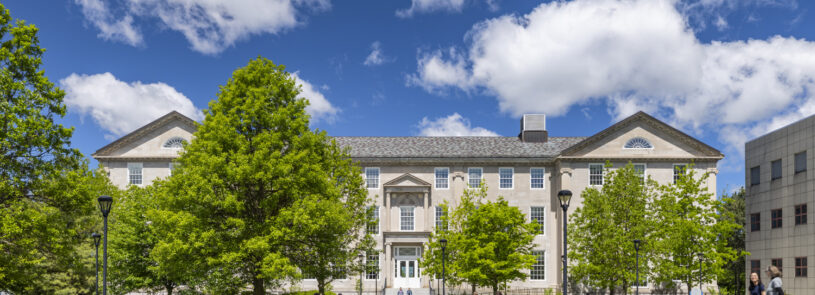
When SUNY University at Buffalo decided to renovate Foster Hall, the goal was to do more than update an aging academic building. The 77,438-sf facility, formerly used for laboratory-intensive programs, was being transformed into a new home for the Graduate School of Education. The renovation offered an opportunity to replace outdated building systems, improve energy performance, and prepare the facility for the university’s evolving campus energy strategy.
IMEG provided mechanical, electrical, plumbing, fire protection, and deep energy retrofit engineering for the project, which earned an ACEC New York Engineering Excellence Diamond Award.
One of the biggest challenges was designing a highly efficient, all-electric heating and cooling system that could work within the existing building and take advantage of the university’s existing infrastructure.
Rather than install conventional geothermal wells, IMEG’s team developed a solution that uses the university’s underground district chilled-water network as both a heat source and a place to reject excess heat. This approach required careful evaluation before design could move forward. Over six months, we monitored water temperatures and building loads to confirm that the existing network could support the proposed system.
The resulting design uses water-source heat pumps to provide heating and cooling throughout the building, while dedicated ventilation units bring in fresh outdoor air. The system recovers energy from outgoing air to reduce the work needed to condition incoming air. It also adjusts ventilation based on occupancy, helping maintain indoor air quality without unnecessarily conditioning more outside air than the building needs. Improved air filtration further supports a comfortable learning environment.
The project involved more than mechanical upgrades. IMEG designed new electrical distribution, emergency power, lighting, plumbing, fire protection, communications, and building controls. LED lighting with occupancy sensors reduces energy use when spaces are unoccupied. New plumbing fixtures conserve water, while updated fire protection and life safety systems support occupant safety. Emergency power was carefully coordinated with the existing generator at neighboring Squire Hall, allowing Foster Hall to maintain essential building functions during a power interruption.
The renovation required fitting entirely new systems into an existing structure while coordinating with the university’s campus infrastructure and future energy plans. The mechanical system was designed to accommodate potential connections to planned campus geothermal wells and central heating and cooling improvements, giving the university flexibility as its energy network evolves.
Completed in August 2025, Foster Hall demonstrates how universities can extend the useful life of existing buildings while making meaningful improvements in energy performance and functionality. Rather than starting over with new construction, the project transformed an existing campus asset into a contemporary academic facility, with building systems designed to serve students, faculty, and the university for years to come.