


Extreme engineering: Powering a science station in Greenland with renewables (podcast included)
By Chris Edward
The National Science Foundation’s Summit Research Station in Greenland is one of the most remote places on Earth, and designing infrastructure for such a location is, to put it mildly, a complex undertaking. That’s what my team and I recently accomplished.
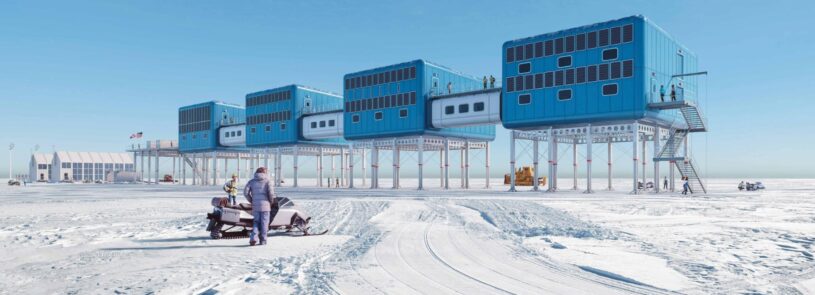
The project is a revitalization and enhancement of the current station, an air testing/sampling site situated more than 10,000 feet above sea level and pretty much as far as you can go from the Greenland coast. The existing site includes several functional structures, most of which had been cobbled together to an extent. This recently prompted the NSF to pursue a long-term, modernized solution that would provide a technologically advanced power plant and multiple linked structures for research and housing for the more than 100 people on site during the summer months.
 From a technical standpoint, this project built upon lessons IMEG learned while designing the NSF’s McMurdo Station in Antarctica. As with the McMurdo project, the environment and scientific purpose shaped nearly every design decision for Summit Station. You can’t compromise air quality by running combustion equipment nonstop, yet you still need reliable power, heat, and life safety systems in an environment that is hostile to both people and equipment.
Logistics also provided a constraint on design. All materials and equipment must arrive by an Air Force-operated, modified C-130, and if a component doesn’t fit inside, it doesn’t go. That reality drove us to redesign systems that are typically installed as single, large pieces. Wind turbines had to become modular structures. Even battery systems raised questions about transport safety and military requirements. We were constantly designing with one eye on performance and the other on whether something could physically make the journey.
Energy is where the project became especially intricate. Historically, Summit Station has relied entirely on jet fuel, which is expensive and difficult to deliver. But cost wasn’t the only driver. Running large generators conflicts with the station’s role as a pristine air sampling facility, so we needed to ensure long stretches of time when combustion systems are simply not operating.
The result is a highly integrated renewable energy system. Wind and solar provide primary power generation, batteries handle short-term fluctuations, and hydrogen serves as long-term energy storage. Excess summer solar energy is converted to hydrogen, stored on site, and later converted back to power and heat using fuel cells. It’s not a single technology that makes this work—it’s the orchestration of all of them, layered with backup systems that ensure resilience even in worst-case scenarios.
Then there’s the snow and ice. Snow accumulation doesn’t stop in summer, so buildings are designed to be jacked up every few years. Solar arrays sit on skids so they can be repositioned as the surface changes. Cabling, supports, and foundations all must tolerate movement over time. Designing for a site that is constantly changing adds a level of complexity not encountered on conventional projects.
Operation of the equipment—essentially a microgrid—is critical, especially in the winter, when only a handful of people remain on site, none of whom are trained in the system’s highly technical complexity. Thus, the microgrid must make intelligent decisions automatically—with monitoring and remote control from the U.S. a vital part of the equation.
At Summit Station, every decision matters, and every system must work together. Designing it all was complex, demanding, and incredibly rewarding—the kind of challenge that pushes our profession forward and drives my team to find creative solutions that help improve our planet.
Listen to the podcast: