


Podcast | WCAP Part II: Climbing the mechanical mountain to net zero carbon
IMEG’s mechanical engineering decarbonization efforts take center stage in this episode of The Future Built Smarter podcast, the second in a three-part series on the firm’s 2026 Whole Carbon Action Plan (WCAP).
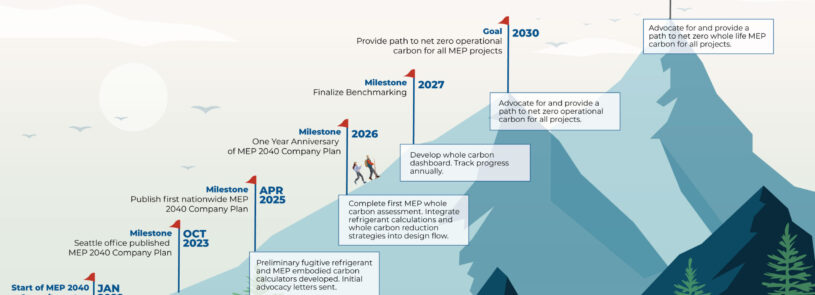
Guest Lindsey Chappelle, an IMEG senior sustainability & energy engineer, explains that the mechanical component of the plan aligns with MEP 2040, the industry-wide mechanical decarbonization initiative. “This is the MEP firms’ commitment to be net zero operational carbon on projects by 2030 and net zero embodied carbon by 2040,” she says. “IMEG is a signatory of MEP 2040 and we have produced our mechanical plan, which has been incorporated into the Whole Carbon Action Plan.”
 As with the WCAP’s structural and infrastructure initiatives, the plan lays out the goals, tasks, tools, and strategies for reducing and eventually eliminating operational carbon emissions (due to mechanical systems), embodied carbon of the mechanical equipment, and the carbon due to refrigerant leakage associated with certain HVAC systems. “Refrigerants are kind of weird. They don’t really fall into embodied carbon or operational carbon,” Lindsey says. “They’re kind of their own item.” Refrigerants, however, can have a sizeable impact. In one pilot project, leakage accounted for roughly 15% of total MEP-related carbon emissions.
While the industry has a firm grasp on how to reduce operational carbon, mechanical engineers face challenges in getting the data needed to address embodied carbon. Among the causes are Revit models that don’t include the number and brand of various types of equipment, and manufacturers who are slow to issue Environmental Product Declarations (EPDs) for mechanical equipment. These third-party documents, which Chappelle likens to “a nutritional facts label,” are essential for understanding the amount of embodied carbon in any piece of equipment. Unfortunately, as she points out, “a lot of vendors haven’t even heard of an EPD.”
To address this issue, IMEG and other firms aligned with MEP 2040 are strongly encouraging manufacturers to provide this information; some firms, including IMEG, are even signaling that future design specifications may require it.
Meanwhile, IMEG has efforts underway to integrate design tools with available databases to provide real-time feedback. “Ideally in the future, this is going to be some kind of automated calculation,” Lindsey says, allowing engineers to immediately see the carbon implications of their design choices.
Lindsey is excited to be helping to bring clarity to a once opaque aspect of building design. “There’s always just been kind of a rule of thumb applied to the embodied carbon of MEP systems, and no one’s taken the effort to calculate it. So it’s exciting to just have the numbers and be able to back it up with reasonable resources and assumptions, see the overall carbon emissions related to a project, and then be able to make some great design decisions.”
Listen to the podcast:
Listen to the introductory and structural episodes in this series, and read IMEG’s 2026 Whole Carbon Action Plan.