

Podcast | Net zero carbon on all projects by 2050? IMEG has a plan to reach the goal
First in a three-part series on IMEG’s Whole Carbon Action Plan.
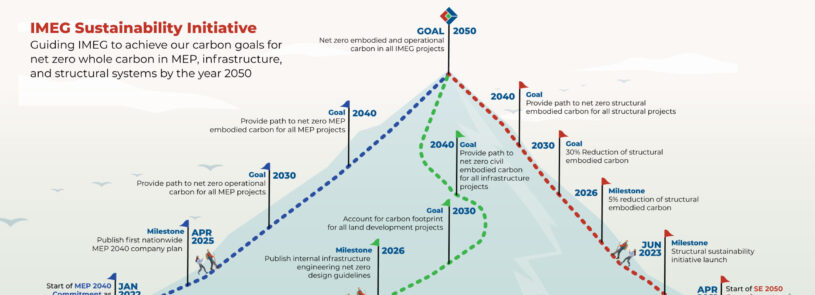
Can an engineering firm reach net zero embodied and operational carbon on all its projects by 2050? If so, what must be accomplished between now and then? Answers to these questions and more are discussed on the IMEG podcast in an episode featuring IMEG’s Director of Sustainability, Adam McMillen.
Adam has been working with IMEG’s multidisciplinary Sustainable Design Task Force to issue the firm’s 2026 Whole Carbon Action Plan, or WCAP. The 2026 WCAP is the third iteration of IMEG’s carbon reduction initiatives; the 2024 plan—then a structural-only document—was the first in an annual requirement of the embodied-carbon-focused SE 2050 Commitment Program. Since then IMEG has expanded its plan to include MEP and civil infrastructure initiatives. The 2026 WCAP therefore provides a comprehensive strategy for reducing embodied and operational carbon, continuing to align with SE 2050 as well as with MEP 2040, the mechanical-focused initiative. IMEG’s multidisciplinary plan is unique to the industry.
“It’s one of our biggest differentiators,” Adam says of IMEG’s approach. “All these initiatives are in sync and everything’s speaking the same language. We see the Whole Carbon Action Plan as an opportunity to simplify and streamline things as one solution—one low-carbon approach—that a client can really get behind.”
 The WCAP is divided into four sections: Education, Report, Reduce, and Advocate—each one delineating individual and multidisciplinary goals and tasks, completed goals and tasks, and the tools that have been or will be created by IMEG to assist its designers in delivering time-efficient, scalable sustainable solutions.
While all sections of the WCAP are critical, the first, Educate, provides the means for achieving quick reductions at no additional cost. For example, just by understanding what embodied carbon is and the differing carbon levels of materials can have a big impact. “It’s a huge opportunity just to understand that if I choose recycled content in my steel, that makes a big difference,” says Adam. “Finding five to 10 things per discipline and getting people to “do this, not that” can lead to significant carbon reductions with no cost to the owner.”
The firm’s use of artificial intelligence does create a carbon footprint of its own from the energy used to run the computations at data centers. However, IMEG tracks its carbon footprint and has found that the project carbon reductions enabled by its sustainable designs far outweigh the AI carbon footprint of the design process. “We estimate that applying AI to our projects has the potential to avoid over 10,000 tons of carbon emissions for every one ton that it consumes,” says Adam.
How realistic is IMEG’s goal of achieving net zero embodied and operational carbon on all its projects by 2050?
“That’s a great question,” says Adam. “Yes, we’re taking a risk by saying we’re going to reach that. But why not set the framework to try?”
Listen to the podcast:
Listen to the mechanical and structural episodes in this series, and read IMEG’s 2026 Whole Carbon Action Plan.