

WCAP Part III: The structural trail to net zero carbon by 2050
In the final installment of a three-part series on IMEG’s 2026 Whole Carbon Action Plan (WCAP), senior sustainability and energy engineer Laura Hagan discusses how the company is tackling embodied carbon in structural systems.
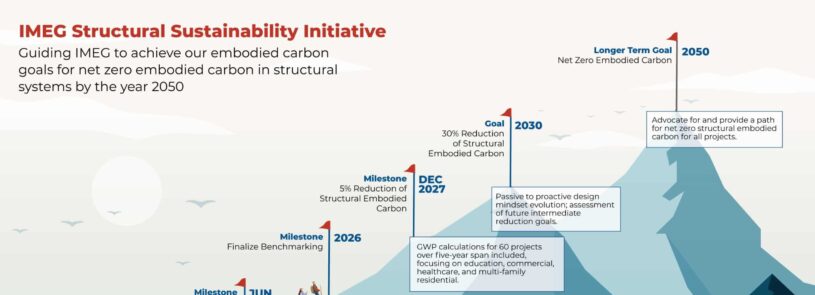
IMEG’s carbon reduction journey began four years ago when the firm became a signatory to SE 2050, the structural engineering industry’s initiative to eliminate embodied carbon in structures by the year 2050. That original structural-focused plan has evolved into IMEG’s broader WCAP, which now also incorporates MEP and infrastructure disciplines.
Laura, who also is a structural engineer, says SE 2050 “is a great program to be a part of because it really challenges us to be accountable for how we are designing and how we are trying to reduce embodied carbon.” Critical to this effort is first being able to measure the carbon impacts across IMEG’s large national project portfolio.
 “We are in the process of trying to figure out what our designs mean in terms of carbon emissions,” Laura says. “Unfortunately, with the size of IMEG, it’s not possible for us to do a whole building lifecycle assessment on every project the firm designs. So instead, we are using material schedules we created in Revit to calculate the quantities of materials in a structural model. Then we are going to transfer the quantities to an internal IMEG database that will multiply them by global warming potential (GWP) factors. This will give us a preliminary high-level assessment of the amount of embodied carbon a structural project is going to emit.” IMEG also will analyze the data for benchmarking purposes, she adds.
“When we are able to make this connection with the internal database, the designers and structural engineers will be able to see, in real time, the projected embodied carbon emissions of the quantities of materials that they are designing with,” Laura says. Engineers can then test different framing layouts, slab thicknesses, or material quantities and immediately see the impact on emissions. “Anyone who’s familiar with embodied carbon knows that if you can reduce the quantity of the material that you have, you’re going to reduce the amount of embodied carbon that you have.”
Laura says even small specification changes can produce meaningful results at scale. She references a case study involving slab-on-grade concrete design in which reducing slab thickness or lowering concrete strength produced a 10 percent to possibly 20 percent reduction in embodied carbon for that building element.
“It’s a great example of low-hanging fruit,” she says. “If you can reduce your quantity and it still performs perfectly for its structural capacities and serviceability requirements, you are going to save carbon and hopefully you’ll save some money too.”
Looking ahead, Hagan says innovation in low-carbon materials is crucial for achieving the long-term SE 2050 goal of net zero structural systems. “Innovation has to happen on the material side, then people have to start designing with it, and it has to make it into building codes as an allowable system. That all takes time, and then you have to build the demand for using the material on projects.”
Laura’s motivation comes from the engineering mindset itself. “We are problem solvers,” she says. “This is basically a giant problem that we don’t have all the solutions to, but it’s something that if we work together and continue to provide pressure to the industry we can reduce embodied carbon.
“People are recognizing that this is important and trying to address it. That’s what keeps me excited and what makes me happy to be doing this work and continuing to push for more every day.”
Listen to the podcast:
To learn more, listen to the introductory and mechanical episodes of this series or read IMEG’s 2026 Whole Carbon Action Plan.